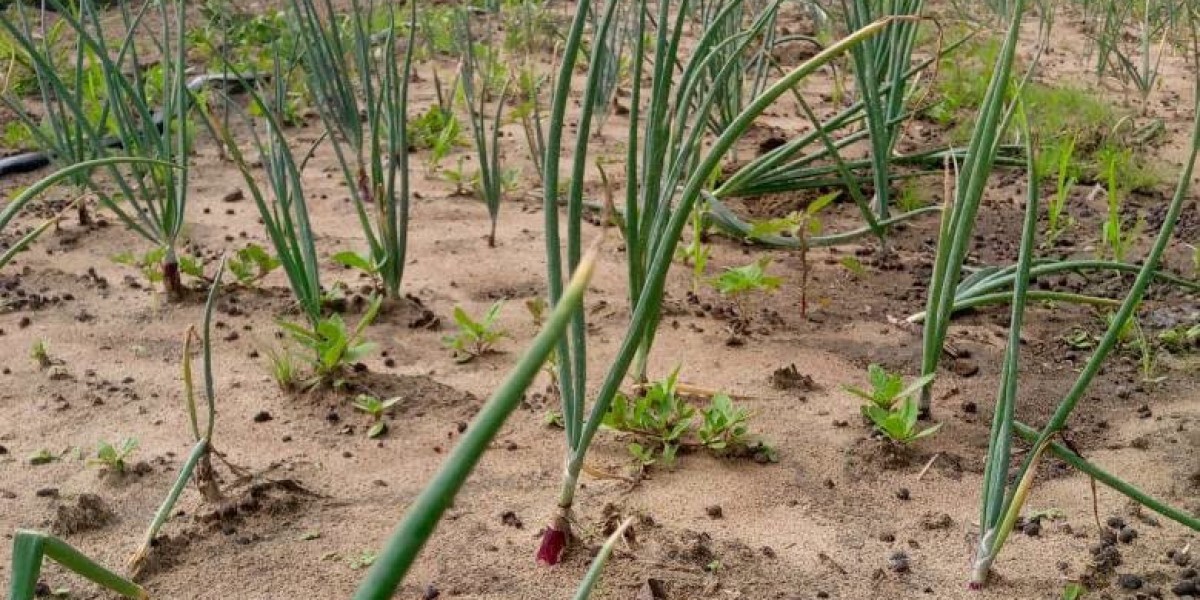
Proper management from land preparation to post-harvest handling is essential for achieving high yields and quality bulbs.
## 1. LAND PREPARATION
 Select well-drained, fertile sandy loam or loam soils with a pH of 6.0–7.0. Clear all weeds, crop residues, and stones. Plough the land deeply (20–30 cm) and harrow until a fine seedbed is obtained. Prepare raised beds where drainage is poor to prevent waterlogging.
2. ONION VARIETIES
Popular onion varieties include:
 Red Creole Bombay Red Texas Grano Red Pinoy Tropicana F1 Safari F1 Red Coach F1
Choose varieties based on market demand, climate suitability, and disease resistance.
3. PLANTING AND SPACING
 Nursery:
*Sow seeds in a nursery bed.
Transplant seedlings when they are 15–20 cm tall (6–8 weeks old).
Spacing:30 cm between rows.
10 cm between plants.
This gives adequate space for bulb development and air circulation.
4. FERTILIZER REQUIREMENTS
Before planting:
Apply well-decomposed manure (5–10 tons per hectare).Basal Fertilizer:
Compound D or NPK (10:20:10 or equivalent)200–300 kg/ha
Top Dressing:
Urea or CAN100–150 kg/ha split into two applications.
Important:
 Avoid excessive nitrogen after bulb formation as it delays maturity and reduces storage quality.
5. MAJOR PESTS AND CONTROL
 Thrips
Damage:
Silvery patches on leaves.
Leaf curling and reduced bulb size.
Control:
Remove weeds. Avoid overcrowding. Spray:Abamectin
Emamectin Benzoate
Spinosad
Lambda-cyhalothrin
CutwormsDamage:
Cut young seedlings at ground level.
Control:
Field sanitation. Deep ploughing. Spray:Cypermethrin
Lambda-cyhalothrin
Onion MaggotDamage:
Larvae feed on roots and bulbs causing wilting.
Control:
Crop rotation. Destroy infected plants. Use recommended soil insecticides.6. COMMON DISEASES AND MANAGEMENT
 Purple Blotch
Symptoms:
Purple lesions on leaves.
Management:
Good spacing. Avoid overhead irrigation. Spray:Mancozeb
Chlorothalonil
Azoxystrobin
Downy MildewSymptoms:
Pale green patches and grey fungal growth.
Management:
Improve air circulation. Avoid excessive moisture. Spray:Metalaxyl + Mancozeb
Copper-based fungicides
Fusarium Basal RotSymptoms:
Yellowing leaves and rotting bulb base.
Management:
Crop rotation. Use disease-free seed. Improve drainage. Neck RotSymptoms:
Bulb rotting during storage.
Management:
Proper curing before storage. Avoid bulb injuries during harvesting.7. IRRIGATION
 Water regularly during vegetative growth. Reduce watering when bulbs begin maturing. Stop irrigation 10–14 days before harvest to improve bulb quality and storage life.
8. HARVESTING
Harvest when 50–80% of tops have naturally fallen over. Carefully lift bulbs to avoid bruising. Remove excess soil but do not wash bulbs.9. POST-HARVEST HANDLING
Dry onions under shade for 2–3 weeks. Allow necks and outer scales to dry completely. Remove damaged, diseased, and undersized bulbs. Store in a cool, dry, well-ventilated place. Use mesh bags, crates, or racks to allow airflow.Properly cured onions can be stored for several months with minimal losses.
 Successful onion production depends on proper land preparation, balanced fertilization, timely pest and disease control, and careful post-harvest management. Following these practices can significantly increase yields, quality, and profitability.